

I Never Wanted All Eyes on Me ❤️
Sometimes the very things that make us different become the stories that help someone else feel less alone.
Growing up, all I wanted was to be normal.
I wanted to be like my friends, my classmates, and the other kids around me. I wanted to do the things they did, go where they went, and experience childhood without constantly having to think about what my body could or couldn’t do.
I didn’t want to be the girl in the wheelchair.
I didn’t want to be the girl with the rare disease.
I didn’t want to be the girl everyone noticed because something about her was different.
I just wanted to be Tiffani.
But let’s be honest for a minute.
What exactly is normal, anyway?
Because after 36 years on this earth, I’ve come to the conclusion that nobody is normal. We all have our differences, struggles, quirks, and stories. Some are simply easier to see than others.
Of course, try explaining that to a little girl who just wants to fit in with her friends.
Back then, I wasn’t thinking about how my experiences might someday help someone else. I wasn’t thinking about advocacy, writing books, or sharing my story publicly.
I was thinking about being a kid.
And sometimes, being a kid with juvenile dermatomyositis made that a little more complicated.
The Little Girl Who Just Wanted to Fit In
I was five years old when symptoms of juvenile dermatomyositis, or JDM, began changing my life.
There were doctors, tests, treatments, hospital stays, and eventually a diagnosis that most people had never even heard of.
There was also a wheelchair.
Actually, my first wheelchair was pink, because apparently even medical equipment needed a little personality.
But having a pink wheelchair didn’t change the fact that I sometimes wished I didn’t need one at all.
I watched my friends run, play, and participate in activities without having to think twice about whether their bodies would cooperate.
Meanwhile, there were things I had to approach differently.
Sometimes I needed extra help. Sometimes I needed accommodations. Sometimes I had to sit something out or find another way to participate.
And sometimes, I was simply tired of being different.
I didn’t necessarily want special attention. I wanted the same opportunities as everyone else.
I wanted to be invited, even if I couldn’t participate in exactly the same way.
I wanted people to ask me questions instead of making assumptions.
I wanted them to understand that having a disability didn’t mean I couldn’t have fun, make friends, get into trouble, or have the same interests as other kids.
Because underneath the diagnosis, the treatments, and the wheelchair was a little girl who loved horses, swimming, photography, and spending time with the people she cared about.
JDM was part of my life.
It wasn’t my entire identity.
Being Seen Isn’t Always the Same as Being Understood
There’s a difference between someone noticing you and someone truly seeing you.
When you grow up with a visible disability, people notice things.
They notice the wheelchair.
They notice that you walk differently.
They notice when you need assistance or when you can’t participate in something the same way everyone else does.
Sometimes they stare. Sometimes they ask questions. Sometimes they don’t know what to say at all.
And sometimes, even when people mean well, their attention can make you feel more different than you already do.
But what I wanted wasn’t for everyone to pretend my disability didn’t exist.
I wanted them to see beyond it.
I wanted people to recognize that I was capable of doing plenty of things, even if I had to do them differently.
I wanted them to understand that needing help with one thing didn’t mean I needed help with everything.
And perhaps most importantly, I wanted them to understand that inclusion didn’t always mean doing something exactly like everyone else.
Sometimes inclusion meant making a small adjustment.
Sometimes it meant giving me a little extra time.
Sometimes it meant finding a different way for me to participate.
And sometimes it simply meant remembering to invite me in the first place.
Looking back, I realize that what I was asking for wasn’t really normalcy.
I was asking for the chance to belong.
My Childhood Was More Than a Diagnosis
I don’t want anyone reading this to think my childhood was nothing but hospitals, treatments, and difficult days.
Because it wasn’t.
There were plenty of wonderful memories, too.
I had horses that gave me a sense of freedom when my body didn’t always cooperate.
I swam competitively, even though my butterfly stroke looked a little different because my right arm didn’t move quite like my left.
My mom called it my short fin.
For the record, butterfly was never my favorite stroke anyway.
I participated in school activities, made friendships, found ways to adapt, and had teachers and other adults who went out of their way to make sure I had opportunities.
Some of those people probably never realized how much their efforts meant.
And yes, there were times when things were frustrating, unfair, or downright exhausting.
But both sides of that childhood are important.
I wasn’t just a sick child.
I was a child who happened to have a rare disease.
There’s a difference.
And it’s one I hope people remember when they meet children living with disabilities or chronic illnesses today.
The Books I Wish I’d Had
Fast-forward more than 30 years.
Somehow, that little girl who didn’t want everyone looking at her grew up and started writing books about the very experiences she once wished she didn’t have to explain.
Funny how life works, isn’t it?
When I began writing Written Along the Way, I wasn’t setting out to become an author with an entire collection of books.
I simply had a story I felt called to share.
A story about faith, loss, love, friendships, disability, and learning that life doesn’t always go according to plan.
And once I started writing, the words kept coming.
Ten chapters on the very first day.
Apparently, I had a few things to say.
But something happened as I worked on that book.
I started thinking about the little girl I used to be.
I thought about the questions I had growing up and the things I wished other people understood.
I thought about what it might have meant to have a children’s book featuring someone who used a wheelchair, went to treatments, needed school accommodations, and still wanted to do all the things other kids did.
Not a book that made her disability the only interesting thing about her.
A book that showed she was a whole person.
I thought about the classmates who didn’t understand why I sometimes had different rules or needed extra help.
I thought about the teachers who wanted to include me but might not always have known how.
And I thought about the families who were hearing the words juvenile dermatomyositis for the first time.
The parents trying to understand what came next.
The siblings watching their family routines change.
The grandparents, friends, and other loved ones who wanted to help but weren’t always sure what that looked like.
That’s when I realized something.
I couldn’t go back and give little Tiffani the books she needed. But I could create them for someone else.
So that’s what I started doing.
Books for younger children.
Books for older kids and teenagers.
Stories that explain JDM in ways children can understand.
Resources that encourage conversations about disabilities, accommodations, inclusion, and the importance of seeing the person beyond the diagnosis.
And I’m not finished.
Because the more I write, the more I realize how many stories still need to be told.
When Someone Else Started Telling My Story
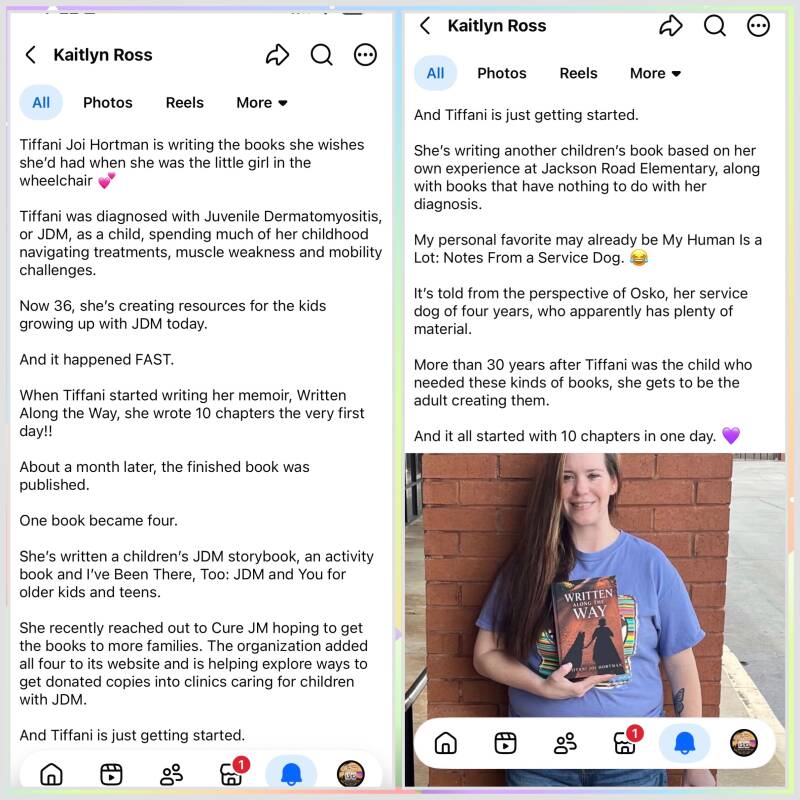
Recently, Kaitlyn Ross shared a story about my writing journey and the books I’ve been creating.
And seeing someone else tell my story was a little surreal.
I’ve spent years sharing pieces of my life through conversations, advocacy, and eventually my memoir.
But there’s something different about opening social media and seeing someone else explaining why your work matters.
Kaitlyn talked about how quickly this writing journey began.
She shared how one book became several and how my childhood experiences inspired me to create resources for children growing up with JDM today.
She also mentioned my upcoming books, including one inspired by my experiences at Jackson Road Elementary and another told from the perspective of a certain four-legged coworker named Osko.
And yes, apparently My Human Is a Lot: Notes From a Service Dog may already be one of her favorites.
I can’t say I blame her.
Osko has plenty of opinions about living with me, and unfortunately, I suspect most of them are accurate.
But one part of Kaitlyn’s story stayed with me more than anything else.
She pointed out that more than 30 years after I was the little girl who needed these kinds of books, I now get to be the adult creating them.
I sat with that thought for a while.
Because when I was that little girl, I never could have imagined this.
I never imagined writing a memoir.
I never imagined publishing children’s books.
I certainly never imagined a reporter sharing my story and helping those books reach people I might never meet.
And yet, here we are.
I am incredibly grateful to Kaitlyn for taking the time to share what I’ve been working on and for helping bring attention to a disease that still needs so much more awareness.
But her story also made me think about something I’ve struggled with for much of my life.
Being seen.
I Never Wanted All Eyes on Me
I’ve never been someone who particularly wanted to be the center of attention.
Growing up, I already felt like I stood out enough.
I didn’t need another reason for people to look at me.
And even now, putting personal pieces of my life out into the world isn’t always easy.
Writing about difficult experiences is one thing.
Knowing that friends, family, acquaintances, and complete strangers might read those experiences is another.
There are parts of my story that are deeply personal.
There are memories that still hurt.
There are experiences I spent years trying to understand myself before I ever considered explaining them to someone else.
And now I’m sharing some of those things publicly.
Not because I suddenly became comfortable with everyone knowing my business.
Not because I think my life is more important or more interesting than anyone else’s.
And certainly not because I believe I have all the answers.
I’m sharing because somewhere out there is a child who may be going through something similar.
A little girl who wants to play with her friends without feeling different.
A little boy who is frustrated because his body won’t cooperate.
A teenager who is tired of explaining why they need accommodations.
A parent who is overwhelmed by a diagnosis they never expected.
A sibling who loves their brother or sister but is struggling to understand why so much attention is focused on medical needs.
Or an adult who has carried the experiences of childhood illness for decades and is only now finding the words to explain them.
Those are the people I think about.
Those are the people I hope these stories reach.
And if being a little uncomfortable in the spotlight helps make that happen, then maybe the discomfort is worth it.
This Isn’t Just About JDM
Juvenile dermatomyositis is a huge part of my story, and it always will be.
But the lessons I’ve learned along the way reach beyond one diagnosis.
Children living with other chronic illnesses and disabilities want to be included, too.
Parents facing unfamiliar medical challenges need support, too.
Siblings of children with complex medical needs deserve to have their experiences recognized, too.
And people living with invisible disabilities deserve understanding, even when the world can’t immediately see what they’re dealing with.
That’s one reason I’ve started exploring books beyond my own diagnosis.
Because inclusion, kindness, friendship, resilience, and belonging aren’t limited to one medical condition.
And sometimes the most important thing a book can do isn’t explain a disease.
Sometimes it’s simply helping a child understand that being different doesn’t mean being less.
That needing help doesn’t make someone incapable.
That accommodations aren’t unfair advantages.
And that every child deserves the opportunity to participate, learn, make friends, and feel valued.
I want children to recognize themselves in the stories I write.
But I also want children who have never experienced disability to read those stories and develop a little more understanding of the people around them.
Because awareness matters.
But understanding and inclusion are what we do with that awareness.
Why I’m Willing to Be Seen
For most of my childhood, I wanted people to look beyond my diagnosis and see the person I was.
Now, I’m choosing to share the very experiences that once made me feel different.
And that’s something I never expected.
I don’t know how many families these books will reach or how many people will eventually read my story.
But I know why I’m writing them.
If a child feels less alone, if a parent finds the words to explain something difficult, if a sibling feels understood, or if a teacher discovers another way to include a student, then sharing my story has been worth it.
I don’t need everyone to know my name.
But I would love for more people to know about juvenile dermatomyositis.
I would love for children with disabilities and chronic illnesses to see themselves represented in books.
And I would love for more families to know that they aren’t walking these journeys alone.
So no, I still don’t particularly want all eyes on me.
But if standing in the spotlight for a little while means helping another child feel seen, understood, and included, then so be it.
I spent years wanting to blend in. Now, if standing out means helping someone else feel like they belong, I’m willing to be seen.
Because this was never just about me. ❤️
Special thanks to Kaitlyn Ross for taking the time to share my writing journey and helping these stories reach more families.
https://www.facebook.com/share/1XtNLNqxoL/?mibextid=wwXIfr
Tiffani Joi Hortman
www.tiffanijoihortman.com
Add comment
Comments